Defining Turnkey PCB Assembly
Turnkey PCB assembly is a manufacturing service model in which the contract manufacturer (CM) takes responsibility for the entire production process from component procurement through finished, tested boards — the customer hands off design files and receives complete assemblies. The term comes from the broader construction industry: a "turnkey" project is one where the customer simply turns a key and the thing works.
In practice, turnkey means your CM buys all the components on your bill of materials (BOM), kits them against your design, runs the assembly process (solder paste printing, pick-and-place, reflow, any through-hole work), performs inspection and functional test, and ships finished boards to your dock or directly to your customer.
This is in contrast to consignment assembly, where you provide all the components and the CM provides only labor and equipment.
Turnkey vs. Consignment vs. Partial Turnkey
These three models represent different points on the spectrum of customer vs. CM supply chain responsibility. Understanding the tradeoffs is fundamental to structuring your manufacturing program correctly.
Consignment Assembly
You purchase all components from your preferred distributors, kit them, and ship them to the CM. The CM assembles only. You retain full control over the supply chain, vendor selection, and component cost — but you also carry all the inventory risk, shipping coordination, and shortage liability. Consignment can make sense when you have tight component cost control requirements, pre-negotiated pricing with distributors, or proprietary/sole-source parts that the CM cannot buy on your behalf.
Partial Turnkey
A hybrid model where you provide some components (typically specialty, long-lead, or proprietary parts) and the CM procures the rest from its distributor relationships. Partial turnkey is extremely common in practice — many programs have a handful of customer-supplied parts alongside a CM-procured BOM. This gives you control where it matters while offloading commodity procurement to the CM.
Full Turnkey
The CM procures everything. You provide Gerber files, BOM, assembly drawings, and test requirements. The CM does the rest. This model minimizes your internal overhead, simplifies your vendor management, and leverages the CM's purchasing volume and distributor relationships — which typically means better pricing and lead times on commodity components than a small design firm can negotiate independently.
What the Contract Manufacturer Handles in Turnkey
A full-turnkey engagement typically encompasses the following scope:
BOM Procurement and Component Sourcing
The CM's purchasing team quotes your BOM across its approved distributor network (Digi-Key, Mouser, Arrow, Avnet, TTI, and others). For parts with supply constraints or long lead times, the CM will flag them early and suggest alternatives if needed. Reputable CMs source only from franchised distributors or authorized channels to avoid counterfeit components — ask about their counterfeit mitigation policy explicitly.
Incoming Inspection and Kitting
Received components are logged against the BOM, checked for date codes, lot traceability, and condition, then kitted into per-job packages organized by the assembly process sequence. Proper kitting prevents mix-ups that cause costly rework.
PCB Procurement
Many turnkey CMs also procure bare PCBs from their preferred fabrication partners, applying the same volume pricing advantages. You provide Gerber files and fab notes; the CM manages the fab relationship.
Assembly
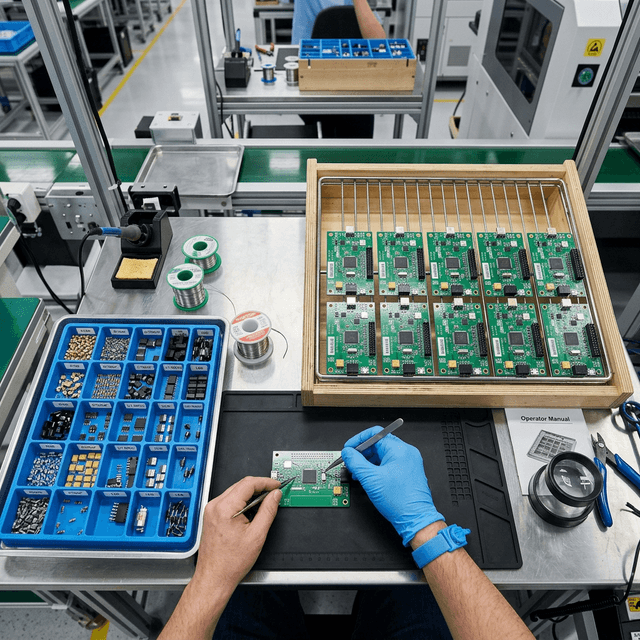
The full SMT and through-hole assembly process: stencil printing, pick-and-place, reflow, wave or selective soldering, any manual assembly steps.
Inspection
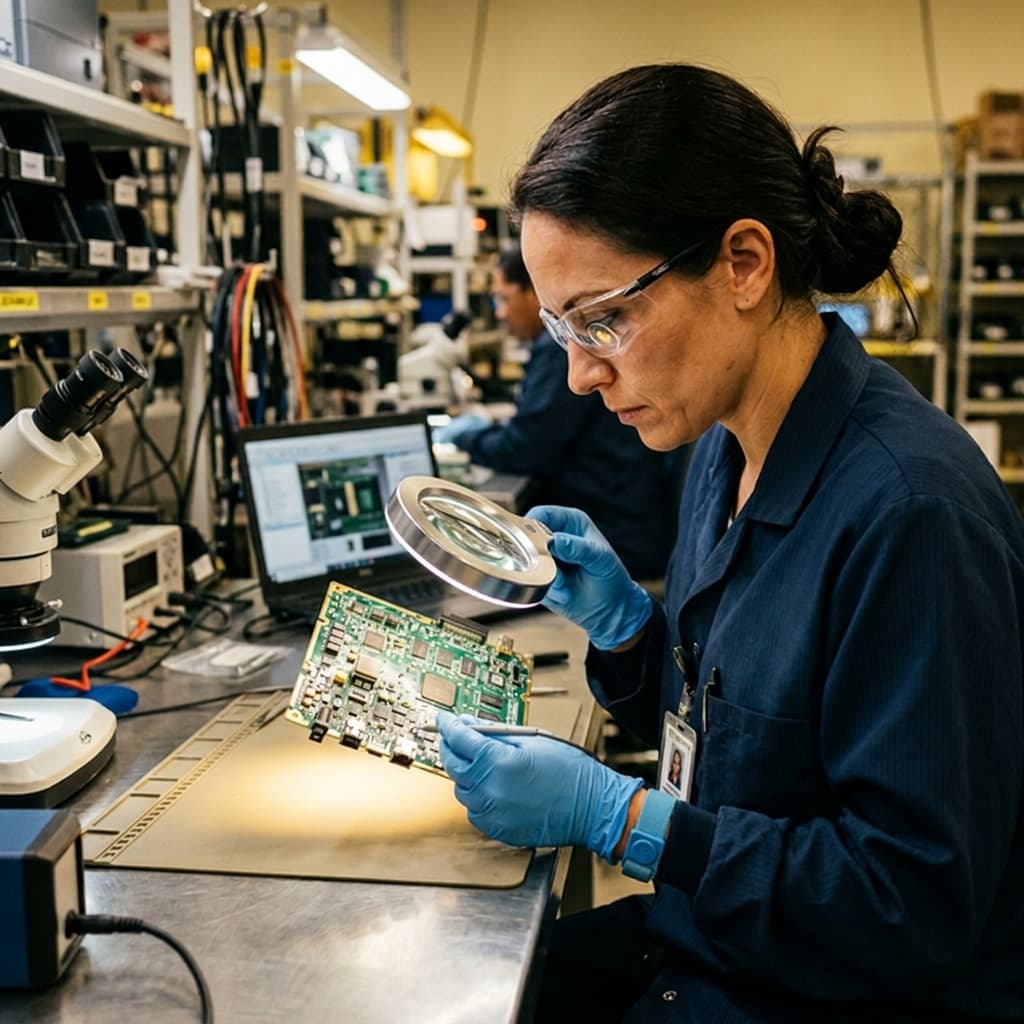
Automated Optical Inspection (AOI) after reflow, X-ray inspection for BGAs and other hidden-joint packages, and IPC-A-610 workmanship inspection by trained operators.
Functional Test
If you provide a test fixture and test procedure, the CM can perform in-circuit test (ICT) or functional test before shipment. This is a critical step for catching defects that pass visual and AOI inspection.
What You Need to Provide
Even in a full-turnkey engagement, the customer is responsible for providing complete, accurate design documentation. Incomplete or ambiguous documentation is the most common cause of delays, wrong builds, and unnecessary back-and-forth. At minimum, provide:
- Gerber files (or ODB++): Copper layers, silkscreen, soldermask, drill files, board outline.
- Bill of Materials (BOM): Complete, with manufacturer part numbers (not just descriptions), reference designators, quantities, and any approved alternatives.
- Assembly drawings (Centroid/pick-and-place file): Component placement coordinates, rotation, and side (top/bottom).
- Fab notes and stack-up specification: Board thickness, copper weight, surface finish (HASL, ENIG, OSP), via tenting requirements, controlled impedance traces if applicable.
- Test requirements: What does "functional" mean for your board? Provide a test procedure, fixture design files, and pass/fail criteria if you want functional test performed.
- IPC class: Specify the required workmanship class (1, 2, or 3) explicitly.
How Turnkey Pricing Works
Turnkey quotes bundle several cost elements that are sometimes quoted separately in consignment engagements:
- Component cost: The CM's landed cost for all BOM parts plus a procurement markup (typically 10–20% for the sourcing and logistics overhead).
- PCB cost: Bare board cost plus any fab markup.
- NRE (Non-Recurring Engineering): One-time setup fees covering stencil fabrication, programming of pick-and-place machines, and first article inspection.
- Assembly labor: Per-unit or per-board labor, typically quoted as a flat per-board rate plus a per-component rate.
- Test: If ICT or functional test fixtures are required, fixture fabrication is a one-time NRE; test labor is per-board.
Turnkey is almost always the right model for companies without dedicated supply chain infrastructure. The simplicity of a single vendor relationship, consolidated invoicing, and transferred supply chain risk is worth the markup on components for most design firms, startups, and mid-sized OEMs.
EMS Technologies
Electronic Manufacturing Insights